
-10%

The Oxford Handbook Of International Relations
Original price was: ₹2,570.00.₹2,313.00Current price is: ₹2,313.00.
5 in stock
📚 Institutional & Library Orders
Universities, colleges and libraries can request bulk discounts for multiple copies.
Contact us: gyanavipublishers@gmail.com
Additional information
| Author | . |
|---|---|
| Publisher | OUP |
| Binding | Paperback |
| ISBN | 9780199585588 |
Related products
-17%
Environmental Chemistry
Original price was: ₹2,450.00.₹2,050.00Current price is: ₹2,050.00.
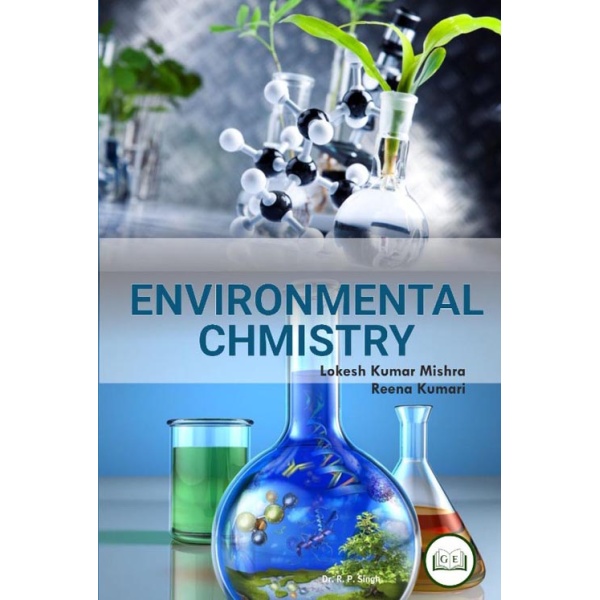
This book has been designed to provide fundamental knowledge of the principles related to environment and its chemistry so as to meet the challenging requirements of students, teachers as well as researchers of Environmental Sciences, Environmental Chemistry and Environmental Studies at graduate, postgraduate, polytechnic and engineering levels at all Indian Universities.
It emphasizes that all living and nonliving parts of our environment are made up of chemicals and that all of the natural processes continuously occurring in the environment involve chemical reactions. The book tries to present the topics that are essential to understand the chemical process in our environment—involving air, Water and Soil. With this concept of interdependence, students begin to see that without some understanding of chemistry, it is impossible to fully understand environmental issues such as ozone depletion, global warming, air and water pollution and the hazards of radioactivity. This book is also useful for the students and teachers of general science.
-17%
Environmental Chemistry
Original price was: ₹2,450.00.₹2,050.00Current price is: ₹2,050.00.
This book has been designed to provide fundamental knowledge of the principles related to environment and its chemistry so as to meet the challenging requirements of students, teachers as well as researchers of Environmental Sciences, Environmental Chemistry and Environmental Studies at graduate, postgraduate, polytechnic and engineering levels at all Indian Universities.
It emphasizes that all living and nonliving parts of our environment are made up of chemicals and that all of the natural processes continuously occurring in the environment involve chemical reactions. The book tries to present the topics that are essential to understand the chemical process in our environment—involving air, Water and Soil. With this concept of interdependence, students begin to see that without some understanding of chemistry, it is impossible to fully understand environmental issues such as ozone depletion, global warming, air and water pollution and the hazards of radioactivity. This book is also useful for the students and teachers of general science.
-18%

Food Chemistry and Chemistry of Living System (Objective Question Bank)
Original price was: ₹395.00.₹325.00Current price is: ₹325.00.
The present book “Food Chemistry and Chemistry of Living System” is primarily designed for undergraduate and postgraduate students of community science (home science), food technology, food science and human nutrition, agriculture, biochemistry, microbiology and biotechnology. In this book, questions are substantially acquired from different competitive examinations. A wide coverage of entire subject divided into eight chapters viz. Food, Carbohydrates, Vitamins and Minerals, Proteins, Nucleic acids, Lipids, Enzymes & Fatty acids, Structure and Function of Cell Organelles, Reactions, Cycles and Phenomena. This book consists of Chapter-wise objective type questions like Multiple Choice, Fill in the Blanks, Mark True or False and Match the Column will enable the readers/aspirants to update their knowledge quickly. This book would be very useful for those appearing for various competitive examination, like Post-graduate, SAUs Entrance, Ph.D. JRF, ARS, ICAR- NET, SET, Civil Service Examinations (State and Central), Agricultural Officer, Bank (PO) (Agriculture), ADO and Allied Agricultural Examinations.
-18%
Food Chemistry and Chemistry of Living System (Objective Question Bank)
Original price was: ₹395.00.₹325.00Current price is: ₹325.00.
The present book “Food Chemistry and Chemistry of Living System” is primarily designed for undergraduate and postgraduate students of community science (home science), food technology, food science and human nutrition, agriculture, biochemistry, microbiology and biotechnology. In this book, questions are substantially acquired from different competitive examinations. A wide coverage of entire subject divided into eight chapters viz. Food, Carbohydrates, Vitamins and Minerals, Proteins, Nucleic acids, Lipids, Enzymes & Fatty acids, Structure and Function of Cell Organelles, Reactions, Cycles and Phenomena. This book consists of Chapter-wise objective type questions like Multiple Choice, Fill in the Blanks, Mark True or False and Match the Column will enable the readers/aspirants to update their knowledge quickly. This book would be very useful for those appearing for various competitive examination, like Post-graduate, SAUs Entrance, Ph.D. JRF, ARS, ICAR- NET, SET, Civil Service Examinations (State and Central), Agricultural Officer, Bank (PO) (Agriculture), ADO and Allied Agricultural Examinations.
-23%

Hydroponics: Technique and Practices
Original price was: ₹2,650.00.₹2,050.00Current price is: ₹2,050.00.
This book provides detailed information on how to design, set up and operate hydroponic culture systems. The text describes the most successful growing cultures to use with specific crops and details media as well as hydroponic techniques. Chapters cover Introduction to hydroponics, site considerations, alternatives, hydroponics equipment, nutrient film technique (NFT) culture, rockwool culture, aggregate culture, other techniques: selected examples, greenhouse operation, plant culture in hydroponics, vegetable crops, berry and other fruit crops, flower crops, other crops, the management of a commercial hydroponic farm, hydroponics troubleshooting, pest, disease and weed management in hydroponics, plant nutrient solutions, automation of, protected cultivation technology, protected hydroponics structures and more. This book is ideal for agronomists, horticulturalists, greenhouse and nursery managers, progressive farmers, extension specialists, and people interested in soilless culture plants.
-23%
Hydroponics: Technique and Practices
Original price was: ₹2,650.00.₹2,050.00Current price is: ₹2,050.00.
This book provides detailed information on how to design, set up and operate hydroponic culture systems. The text describes the most successful growing cultures to use with specific crops and details media as well as hydroponic techniques. Chapters cover Introduction to hydroponics, site considerations, alternatives, hydroponics equipment, nutrient film technique (NFT) culture, rockwool culture, aggregate culture, other techniques: selected examples, greenhouse operation, plant culture in hydroponics, vegetable crops, berry and other fruit crops, flower crops, other crops, the management of a commercial hydroponic farm, hydroponics troubleshooting, pest, disease and weed management in hydroponics, plant nutrient solutions, automation of, protected cultivation technology, protected hydroponics structures and more. This book is ideal for agronomists, horticulturalists, greenhouse and nursery managers, progressive farmers, extension specialists, and people interested in soilless culture plants.
-21%
Soil Testing and Soil Microbiology
Original price was: ₹1,950.00.₹1,550.00Current price is: ₹1,550.00.
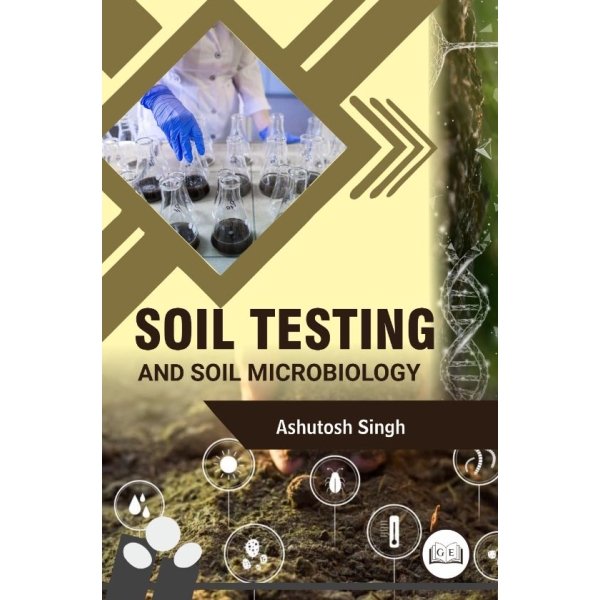
Soil testing informs the farmers of the imbalances in the soil and guides them in adopting specific fertilizers or soil conditioners to deal with the diagnosed issues. These tests can equip us in taking preventive and corrective measures even before sowing the crop, and that results in an un-compromised final yield. Thus, it is evident that the testing of agricultural soil is pertinent in India. The book contains 14 chapters covering all aspects of soil testing and soil microbiology, which include introduction, sanitation safety guidelines of the lab, physical properties of soil analysis, chemical properties of soil analysis, water sample analysis, prepare soil and water health card, manures and fertilizers: nutrient contents and their identification, organic farming, good lab practices, introduction to soil microbiology, soil microbiology and biogeochemical cycle, soil microbiology and biodegradation and biogeneration, effect of pesticides and other chemicals on the soil, microbiology of the soil and its analysis. It is hoped that this book will be useful for scientists, teachers, students and lab-technicians associated with soil and plant analysis.
-21%
Soil Testing and Soil Microbiology
Original price was: ₹1,950.00.₹1,550.00Current price is: ₹1,550.00.
Soil testing informs the farmers of the imbalances in the soil and guides them in adopting specific fertilizers or soil conditioners to deal with the diagnosed issues. These tests can equip us in taking preventive and corrective measures even before sowing the crop, and that results in an un-compromised final yield. Thus, it is evident that the testing of agricultural soil is pertinent in India. The book contains 14 chapters covering all aspects of soil testing and soil microbiology, which include introduction, sanitation safety guidelines of the lab, physical properties of soil analysis, chemical properties of soil analysis, water sample analysis, prepare soil and water health card, manures and fertilizers: nutrient contents and their identification, organic farming, good lab practices, introduction to soil microbiology, soil microbiology and biogeochemical cycle, soil microbiology and biodegradation and biogeneration, effect of pesticides and other chemicals on the soil, microbiology of the soil and its analysis. It is hoped that this book will be useful for scientists, teachers, students and lab-technicians associated with soil and plant analysis.
Reviews
There are no reviews yet.